

- Read Time: 4 min read
- Publish Date: May 14, 2021
- Introduction: An exploration of presentation design, storytelling, audience engagement, and the communication of creative ideas through UX design and multidisciplinary practice.
Presentation Design as Visual Storytelling
Presenting creative work effectively requires more than simply organizing information visually. Presentation design also becomes an exercise in storytelling, audience engagement, clarity, emotional communication, and the thoughtful translation of complex ideas into accessible experiences.
During this phase of the AWAKEN [AR]t Installation Project, I focused on refining how immersive concepts, UX thinking, visual storytelling, and experiential design could be communicated more cohesively through presentation structure, visual hierarchy, and narrative flow. The process reinforced how closely creative direction and communication strategy are connected within multidisciplinary design practice.
Presentation design becomes more than visual organization alone — it becomes a form of storytelling capable of shaping engagement, emotion, and audience understanding.
Refining the Communication of Creative Ideas
I also continued to further refine my slides and created a revised version of my presentation. The Major changes made to presentation included:
- Updated the Table of Contents Slide
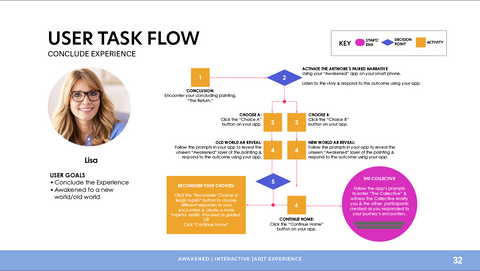
- Added Key/Legend to the Task Flow Diagrams
- Further Developed the Logo & Added a Logo Slide
- Tweaked Layout, Colors, and Alignment on all Slides
- Added Photo to Proof of Concept User Scenario & Refined Scenario
- Removed Paper Prototype Test Slides and Consolidated them into One Test Results Slide
- Removed (2) A/B Test Results Slides
- Updated Change Implementation Slides with High Fidelity Designs
- Added Sources/Bibliography Slide
Visual Hierarchy and Audience Experience
As the presentation evolved, refining visual hierarchy, navigation clarity, storytelling structure, and experiential communication became increasingly important. Adjustments to layout, typography, interaction flow, visual consistency, and conceptual organization helped strengthen the relationship between the project narrative and the audience experience.
The iterative refinement process also reinforced how presentation design functions not only as visual organization, but as a form of storytelling capable of shaping clarity, engagement, emotional connection, and audience understanding.
Selected presentation explorations and visual refinements connected to storytelling, audience engagement, interaction design, and experiential communication.
Task Flow Diagram with added Key/Legend
Logo Slide

Proof of Concept User Scenario

Test Results Slide

Change Implementation Slides (1-5)


Sources/Bibliography Slide

Effective Speaking and Audience Engagement
The process also reinforced how presentation design extends beyond visuals alone. Effective communication often depends on presence, storytelling, audience connection, clarity, pacing, preparation, and the ability to translate complex ideas into meaningful experiences. Visual storytelling and spoken communication ultimately work together to shape how audiences emotionally and intellectually engage with creative work.
Defining Project Scope Through Systems Thinking
Defining project scope became an important part of balancing creative ambition with realistic implementation strategies. Evaluating which aspects of the immersive experience could be refined, tested, and developed over time helped establish a more sustainable framework for long-term creative growth and iterative experimentation.

The Ways to Grow Framework is a great exercise from Design it that helps you determine the scope of your Project. Its a quick and visual way to understand how difficult your design solutions may be to implement.
You can access the Ways to Grow Framework from Design Kit at DesignKit.org | http://www.designkit.org/methods/38
Frameworks such as the Ways to Grow methodology also offered valuable perspective for evaluating scalability, implementation complexity, and long-term development possibilities within experiential design projects.

Research sources, technical references, conceptual studies, and expert perspectives all became important components of building a stronger foundation for both the experiential and technical aspects of the project. Developing a bibliography framework also reinforced the importance of research as an ongoing part of multidisciplinary creative practice.
Looking back, this phase of development reinforced how closely storytelling, presentation design, visual communication, and audience engagement are connected within the broader creative process. Refining how ideas are communicated often becomes just as important as developing the ideas themselves.
The continued evolution of the AWAKEN [AR]t Installation Project remains an exploration of immersive storytelling, experiential design, emotional interaction, and the communication of creative concepts through multidisciplinary artistic practice. The process continues shaping how I approach visual communication, systems thinking, and audience-centered creative experiences today.
Author Bio: Julie Davis is a multidisciplinary artist, floral designer, and creative professional with experience in visual storytelling, UX design, digital content strategy, and floral industry operations. Through writing, design, and artistic practice, she explores the intersection of creativity, connection, resilience, and customer experience.
Related Insights
- Sacred Reflection: Creativity, Stillness, and Meaning
- Growing Up a Military Brat: How Art Became a Form of Resilience
- 5 Ways Florists Can Improve Their Website Customer Experience
- View Portfolio